Vienna Golden Sound Orchestra – professional musicians and soloists from Vienna who combine classical music with new sounds.
Contact Info
Address
Gebrüder-Lang-Gasse 10/71150, Vienna
Phones
+43 664 5705685
Email
contact@arsharmonyevents.com
© 2025 Vienna Golden Sound Orchestra
Musical Heritage of Vienna: from Mozart to Strauss
Introduction
Hardly any other city is so naturally associated with music as Vienna. Mozart’s operas, Beethoven’s symphonies, the waltzes of the Strauss family, the glorious era of the Habsburg monarchy – all of this has turned Vienna into a soundscape that is still admired worldwide today. But Vienna’s musical significance is not only the past: it continues to live on in its concert halls, in new ensembles and in orchestras that deliberately combine tradition with contemporary energy. One of these orchestras is the Vienna Golden Sound Orchestra, which fulfills exactly this promise: where tradition sounds anew.
What makes Vienna so unique?
For centuries, Vienna was the political, cultural and intellectual center of Central Europe. For musicians, this meant: here were the patrons, the courts, the salons and – not to be underestimated – the audience. Composers such as Haydn, Mozart, Beethoven, Schubert and later Brahms and Mahler found in Vienna not only work opportunities, but also an educated public that truly wanted to listen to new music. This combination of patronage, artistic freedom and urban life was the perfect breeding ground for what we now call the Viennese Classical period.
The city as a sound laboratory
Vienna was never just a museum, it was always a workshop. New forms were created here: the classical symphony, the string quartet, the Viennese opera, and later the New Year’s Concert as a cultural ritual. These forms still work today because Vienna has remained a place where music is not only performed, but also nurtured, passed on and reinterpreted. This is why many musicologists say that Vienna is not just a city of music, but a city with its own musical identity.
Tradition does not mean stagnation
A common misconception is that tradition is something rigid. In Vienna it was always different. Most of the great Viennese composers crossed boundaries. Mozart mixed Italian and German influences, Beethoven broke established forms, Schubert turned song into great emotional art, Johann Strauss made dance music respectable. This attitude – respect for the form, but courage to renew it – can still be felt today. This is exactly where the Vienna Golden Sound Orchestra comes in: it takes the language of Viennese music seriously, plays it in a stylistically correct way, but at the same time brings an international, contemporary energy to it. This keeps what we know as the “Viennese sound” from becoming a museum piece – it stays alive.
Why Vienna is still the capital of classical music
- Density of venues: from the Vienna State Opera to the Musikverein and to historic palaces – there are countless stages that were built for classical music and acoustically tailored to it.
- The audience: Vienna still has an audience that knows classical programmes, can place composers and recognizes quality.
- International appeal: performing in Vienna makes a statement. Concerts in Vienna are a reference point. That is why international conductors, soloists and ensembles keep coming back.
- Artistic networks: in Vienna, musicians from many countries meet. This makes it possible to start projects that are rooted in tradition and at the same time open to the international scene – this is exactly how the Vienna Golden Sound Orchestra was created.
Vienna Golden Sound Orchestra: where tradition sounds anew
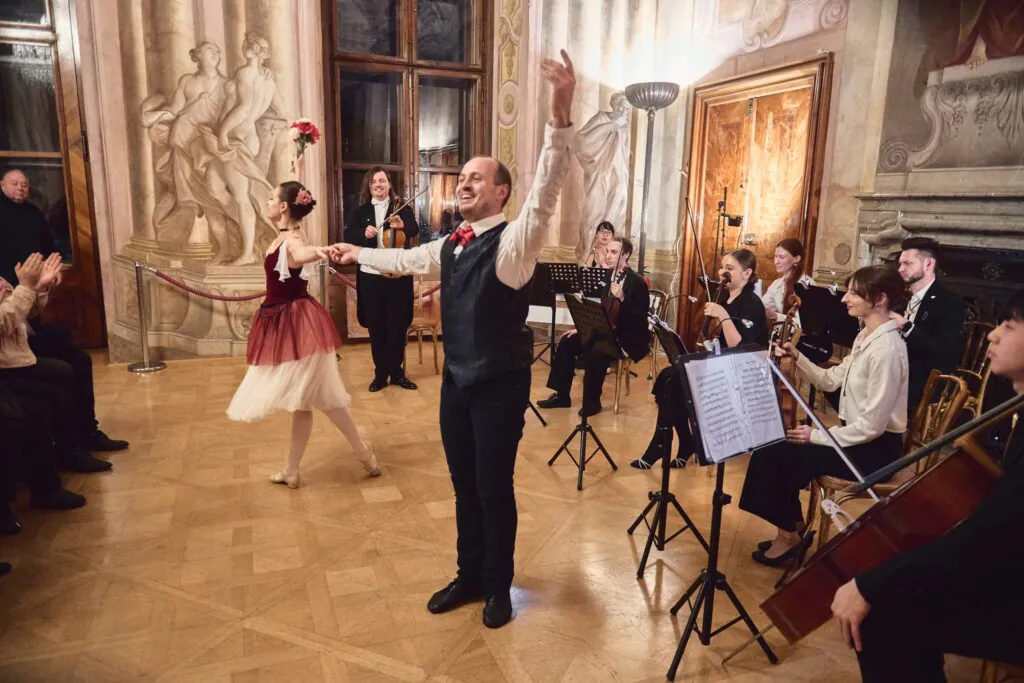
The orchestra is based on the idea of presenting the Viennese musical language the way it was meant to be: elegant, dancing, melodic – but without dust. The programmes combine classics such as Johann Strauss, Mozart or Brahms with works that immediately reach the audience emotionally. The ensemble has proven in Vienna and beyond that this works: when an orchestra takes the Viennese tradition seriously, the audience reacts with enthusiasm – whether in a palace setting or in a major European concert hall.
Motivation: why you should go today
Many people love Viennese music but experience it only through recordings or as background. Live it sounds different. An orchestra like the Vienna Golden Sound Orchestra shows why this music became so great in the first place: because it is physically tangible, because waltzes really have to swing and because the fine irony of Viennese music can only be heard when musicians play it consciously. Anyone who wants to understand Vienna as a city of music should not only look at the sights, but should attend at least one concert of this kind. This is the most direct connection to the culture of this city.
Vienna is the capital of classical music because here tradition is understood not as an obligation but as an opportunity. The city has shaped the music – but music continues to shape the city today. And as long as ensembles such as the Vienna Golden Sound Orchestra continue this tradition, make it visible internationally and open it to both new and experienced audiences, Vienna will remain exactly what it is loved for all over the world: a place where music is not only preserved, but brought to life again and again.